Reading one deal from shuffle to declaration
A first-hand reader's guide to one complete Points rummy round. The numbers track a canonical thirteen-card deal where one joker is in play. The reading is on the table, not on the screen.
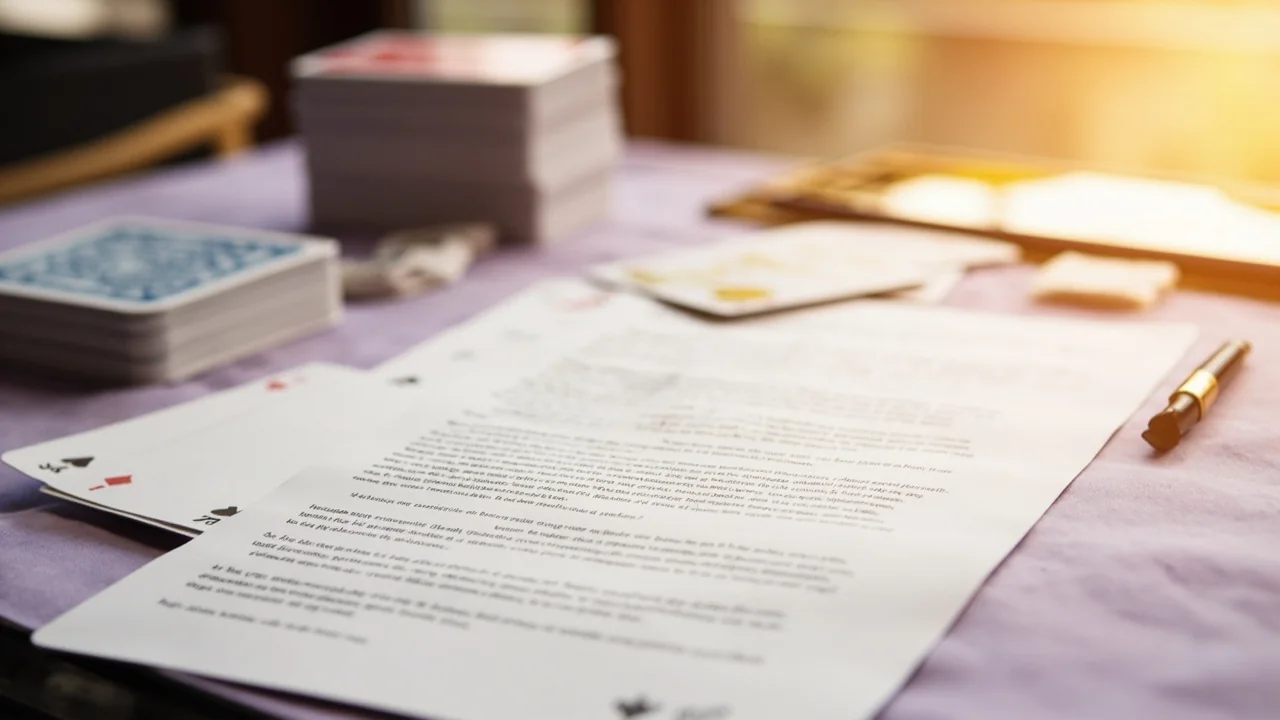
The table before the cards are dealt
A Points rummy game needs a standard fifty-two-card deck, two jokers, and two to six players. The chips are agreed before the deal.
The deck is the standard international pack: thirteen ranks in each of four suits, plus two jokers. The suits are clubs, diamonds, hearts, and spades. The ranks are ace through king. The ace counts as one point and can sit high in a sequence (Q-K-A) or low (A-2-3).
The two jokers are the printed joker and the wild joker. The printed joker has no rank value other than the twenty-five-point penalty if it lands in the loser's hand. The wild joker is drawn from the closed deck at the start of each deal and substitutes for any card in a meld.
The chip pool
Each player contributes a stake to the table. The table pool is the sum of the stakes. A dropped hand pays the drop penalty to the table. A declared show pays the loser's deadwood to the winner. The pool starts at zero and grows as the round progresses.
The thirteen-card deal and the wild joker
Each player receives thirteen cards face down. The remaining deck is the closed deck. The top card is placed face up to start the open deck.
The dealer position is randomly assigned. The player to the right of the dealer picks the first card. The dealer position rotates one player to the left after each deal, so the same player is not dealing throughout the session.
Once the deal is complete, the dealer flips the top card of the closed deck face up to start the open deck. The dealer then draws the next card from the closed deck and turns it face up. The rank of this card is the wild joker for the round. Any card of that rank in any player's hand is treated as a joker for meld purposes.
Reading the wild joker
If the wild joker is a 7, every 7 in any player's hand is a wild joker. A 7♠ can sit in a 5-6-7 meld as a 7, or in a 8-9-10 meld as an 8, and so on. The printed joker is always wild in addition to the wild joker.
The draw-and-discard loop
Each turn: draw one card from the closed or open deck, lay down any completed melds, and discard one card to the open deck. The loop continues until a player declares.
The first turn of the game is taken by the player to the right of the dealer. The player draws the top card of the closed deck, or the top card of the open deck. The card is added to the player's hand, and the player's hand size is now fourteen. The player then discards one card face up to the open deck, and the hand size returns to thirteen.
The turn order moves clockwise. Each player draws and discards once per turn. The closed deck decreases by one card per turn. When the closed deck runs out, the top card of the open deck is set aside, the rest of the open deck is turned face down to form a new closed deck, and the new deck starts with the set-aside card as its open deck.
Drawing from the open deck
Drawing from the open deck is a known card. The player sees the card before picking it. The trade-off is that the opponent two seats to the left has just discarded that card, often for a reason — they did not need it. The reading is that open-deck draws are useful for a struggling hand but signal your need to the rest of the table.
Rules on the open deck
Most platforms enforce a maximum on consecutive open-deck draws. Three or four in a row is the typical ceiling. The ceiling exists to prevent hoarding, which is the practice of discarding in a way that ensures the open deck does not cycle.
When to drop and what the drop costs
Dropping is voluntary. The cost is fixed by the format. The first drop is the cheapest, and the middle drop is the most expensive.
The first drop is taken before the player has drawn any card. The cost is small — typically twenty-five points — and the player gives up the round without seeing any draw. The first drop is the right move when the dealt hand is unplayable: no joker, no clear sequence, and no path to a clean declaration.
The middle drop is taken after the player has drawn but before any declaration. The cost is higher — typically fifty points — and the player keeps the cards already drawn but gives up the rest of the round. The middle drop is the right move when the hand has settled into an unworkable shape.
The full show is the declaration. The player lays down thirteen cards all of which sit in legal melds. The other players verify. A valid show wins the round.
Reading the declaration
The declaration is the end of the round. The cost is the deadwood count. The winner is the player with the lowest deadwood.
A valid declaration requires at least one pure sequence. Two pure sequences are the most common. Sets and impure sequences can complete the rest. The thirteen cards must all sit in legal melds. Any card outside a meld adds to the deadwood count.
The platform's rules on printed jokers and wild jokers are different. A printed joker in the loser's hand counts twenty-five points if unmatched. A wild joker in the loser's hand counts zero if it sits in a valid meld, and fifteen if unmatched. The arithmetic is on the platform's terms page.
Verifying a show
When a player declares, the other players verify the show. The verifier reads the melds for the same suit, the same rank, and the presence of the wild joker. A show with a missed pure sequence is invalid. A show with a missed or wrong set is invalid. The platform will reject the show and the round continues.
Continue with the scoring ledger
The next read takes the deadwood count and walks through four worked examples. The examples are from a single Points rummy session, with the drop cases added.
Reading the post-deal table
The post-deal table is the table after the deal. The reading is on the table, the player's hand, and the open deck.
The post-deal table is the table after the deal. The reading is on the table, the player's hand, and the open deck. The table is the venue for the round. The player's hand is the cards in front of the player. The open deck is the face-up cards on the table.
The reading is on the table, the player's hand, and the open deck. The reading is on the page, the format, and the edition. The reading is short for a reason — the post-deal table is on the page.
Reading the table
The table is the venue for the round. The reading is on the table, the table's seats, and the table's chips. The table is the desk's first read.
Reading the player's hand
The player's hand is the cards in front of the player. The reading is on the hand, the hand's thirteen cards, and the hand's melds. The hand is the desk's second read.
Reading the open deck
The open deck is the face-up cards on the table. The reading is on the open deck, the open deck's top card, and the open deck's discard pile. The open deck is the desk's third read.
The post-deal table is the venue for the round. The reading is on the table, the player's hand, and the open deck. The reading is on the page, the format, and the edition.
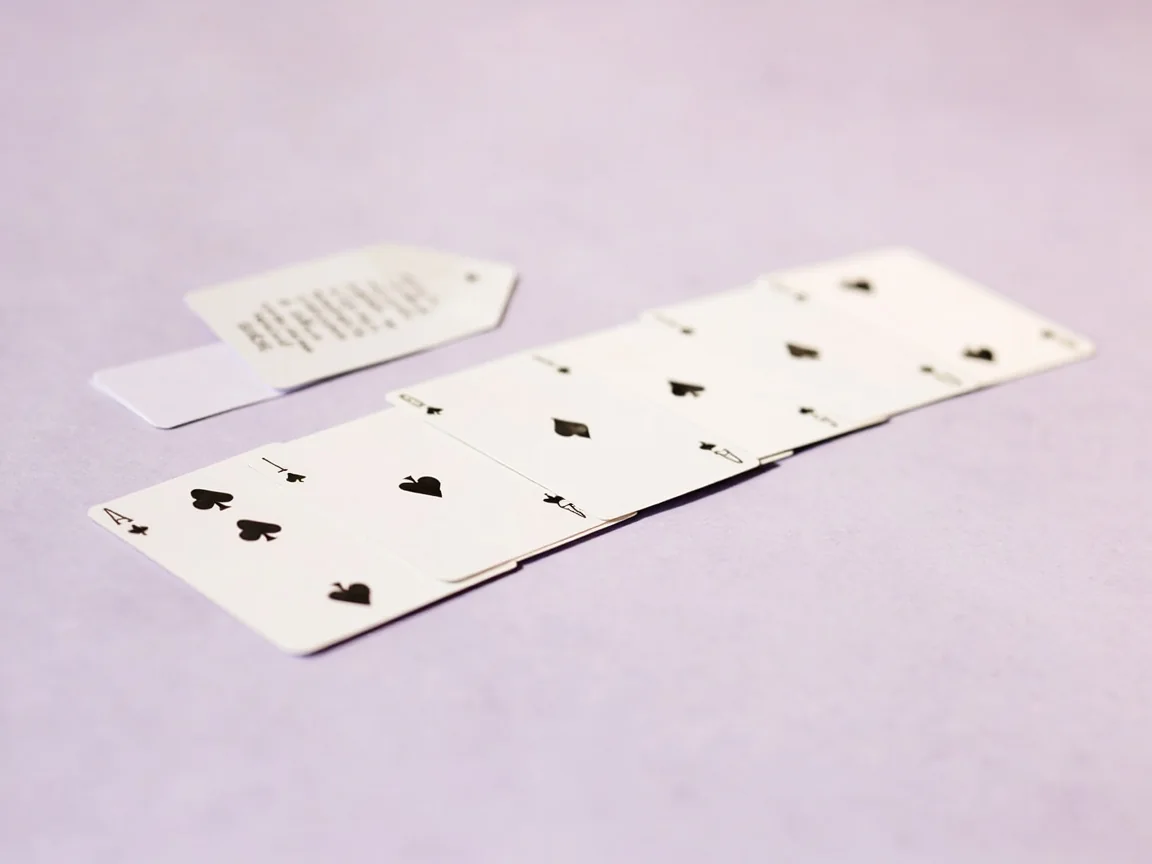
The image on the left is the desk's reading-room visual for this section. The composition is editorial cutout — the prop is isolated on a pale lilac paper surface, with a thin pink rule below the caption. The reading is on the visual, the caption, and the section.
Continue with the scoring ledger
The next read takes the deadwood count and walks through four worked examples. The examples are from a single Points rummy session, with the drop cases added. The reading is on the table, not the screen.